Magnetic Variation and Deviation: Heading Guide
Magnetic variation converts true direction to magnetic direction; deviation corrects the aircraft compass for its own magnetic influences. To go from true heading to magnetic heading, subtract east variation or add west variation, then apply the aircraft’s deviation correction to obtain compass heading. Keep wind correction separate, and reverse each correction when working back toward true heading.

On this page
- What is the difference between course and heading?
- What causes magnetic variation?
- When do you add or subtract variation?
- How does deviation turn magnetic into compass heading?
- How do you convert compass heading back to true heading?
- What happens when the answer crosses north?
- How do you read a FOR and STEER compass card?
- How do you avoid the common heading mistakes?
- Check yourself
- Frequently asked questions
- Sources and next steps
| Key fact | What to remember | Source |
|---|---|---|
| True heading, TH | Where the nose points, measured clockwise from true north | FAA PHAK Chapter 16, pp. 16-6–16-10 |
| Variation | The angle between true north and magnetic north at a location | NOAA magnetic declination |
| True → magnetic | Subtract east variation; add west variation | PHAK p. 16-8 |
| Deviation | Aircraft magnetic influences; use its compass correction card | PHAK Chapter 8, p. 8-25 |
| Magnetic heading, MH | Nose direction relative to magnetic north | PHAK Chapter 16, p. 16-8 |
| Compass heading, CH | The indication to steer after the deviation correction | PHAK Chapter 8, p. 8-25 |
What is the difference between course and heading?
Course describes an intended path over the ground; heading describes where the nose points. A crosswind can make those directions different, so a measured chart course is not automatically the heading to steer.
Label every angle before calculating. A true course, TC, uses true north as its reference. After solving the wind triangle, the resulting true heading, TH, still uses true north. Variation changes the reference to magnetic north, producing magnetic heading. Deviation then translates that direction into the aircraft’s compass indication.
For example, suppose a fictional wind solution requires turning 6° left of an 084° true course. The true heading is 078°. That is the input to the heading conversions below. The 6° is supplied for this exercise; it is not calculated from an unstated wind, and it says nothing about the aircraft’s groundspeed.

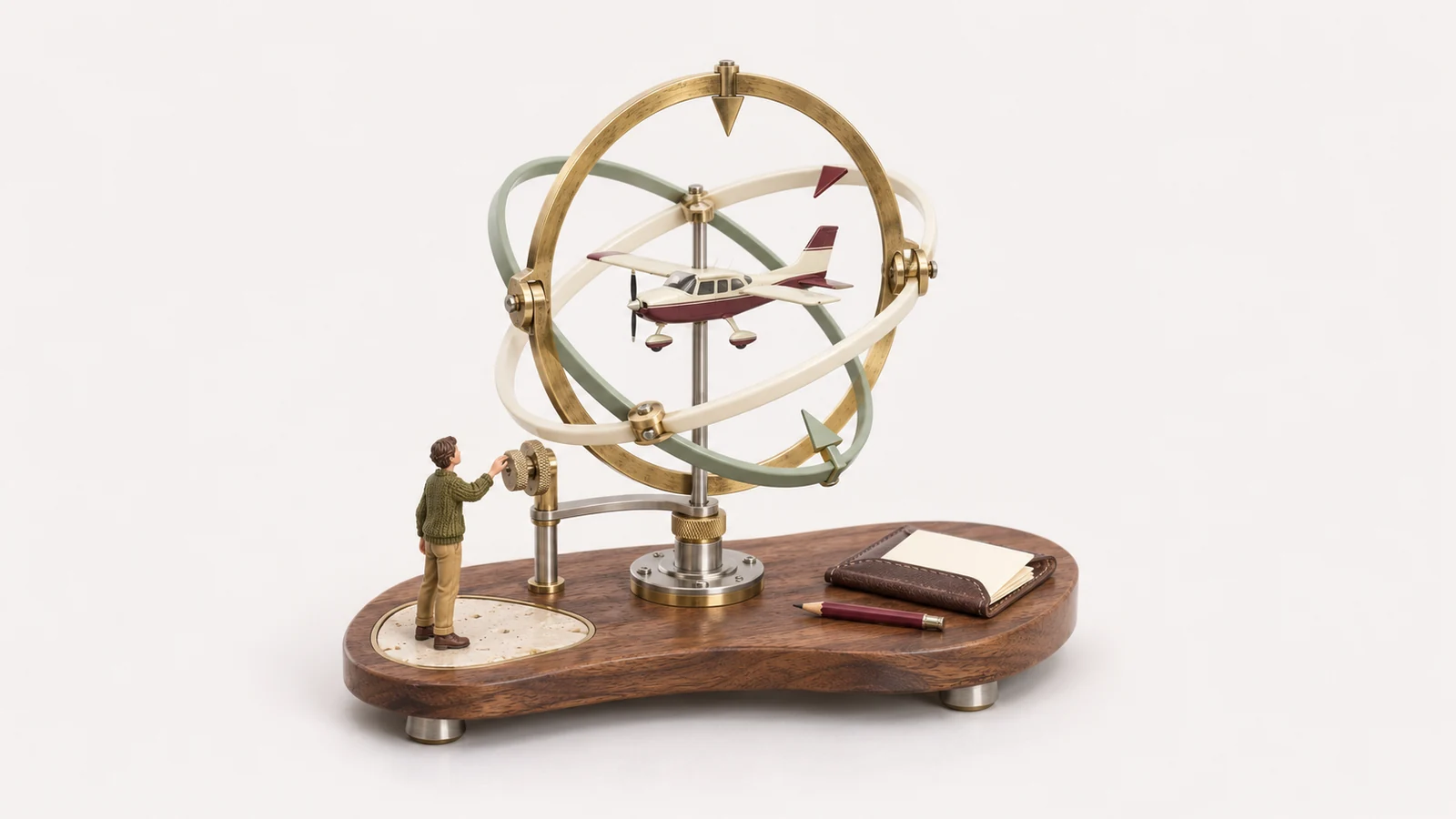
Keep the jobs separate: wind changes the nose direction needed for the intended track; variation and deviation change directional references or indications. Original study diagram based on PHAK Chapter 16.
What causes magnetic variation?
Variation is the local angle between true north and magnetic north, also called magnetic declination. Easterly variation places magnetic north east of true north; westerly variation places it west.
NOAA explains that declination changes with both location and time. A compass responds to the horizontal component of the magnetic field at its location; the convenient phrase “points north” does not mean it literally aims at one fixed point on Earth. Use appropriate current chart information for the route, rather than copying a remembered regional value. NOAA’s explanation gives the underlying definitions.
An isogonic line joins locations with equal variation. A zero-variation line is an agonic line. Neither term gives the deviation of your aircraft. The reference values used here are invented arithmetic inputs, not current variation for a named airport or the location of today’s agonic line.
Start with the broader sectional chart reading guide when you need to connect the conversion to chart work. Check the actual value and its east or west label before entering it in a navigation log.
When do you add or subtract variation?
Going from true heading to magnetic heading, subtract east variation and add west variation. Write the conversion direction beside the arithmetic so the familiar memory aid has a defined job.
With TH 078° and variation 11° east, MH = 078° − 11° = 067°. This is a smaller number because the magnetic reference lies east of the true reference. The aircraft has not physically turned while you change the way its direction is expressed.
For a west example, TH 084° with variation 7° west gives MH 091°. Compare the two examples by asking which reference you start from, rather than deciding the sign from the aircraft’s easterly or westerly heading. A heading toward the east does not make the variation east.
Use three digits and carry the labels through each line. “067° MH” tells the next reader what the number means. “67” by itself does not distinguish a course, a heading, a correction or even a unit.
How does deviation turn magnetic into compass heading?
Deviation accounts for magnetic effects associated with the aircraft; obtain its correction from the applicable compass card. It can differ with heading and with equipment configuration, so another aircraft’s correction is not a substitute.
If an exercise explicitly specifies east or west deviation, the same forward sign convention applies from MH to CH: subtract east deviation and add west deviation. Our main example specifies 2° west deviation at MH 067°, so CH = 067° + 2° = 069°. This is an original study value, not an actual aircraft card.
| Step | Calculation | Result |
|---|---|---|
| Given true heading | Wind correction already completed | TH 078° |
| Apply 11° east variation | 078° − 11° | MH 067° |
| Apply 2° west deviation | 067° + 2° | CH 069° |
| Check the reverse path | 069° − 2° + 11° | TH 078° |
A different card may state the compass indication to steer directly. Read its headings and configuration notes; do not treat an already corrected indication as another correction amount. FAA PHAK Chapter 8, p. 8-25 illustrates this with a FOR/STEER card and separate equipment rows.
How do you convert compass heading back to true heading?
Work backward through deviation first and variation second, reversing the operation used at each forward step. An unexplained “east subtract” rule is incomplete unless you also name the direction of conversion.
Suppose CH is 092°, deviation is 3° east and variation is 8° west. In the forward direction, east deviation would have been subtracted from MH, so undo it by adding 3°: MH is 095°. West variation would have been added to TH, so undo it by subtracting 8°: TH is 087°.
A round trip checks both signs: 087° TH + 8° west variation = 095° MH; then 095° − 3° east deviation = 092° CH. Recovering the original heading is a useful arithmetic check, although it cannot validate a wrong chart value or a wrong aircraft card.

The arrows define the sign convention. Apply deviation to the magnetic-to-compass step, and variation to the true-to-magnetic step; reverse both operations when retracing the path.
What happens when the answer crosses north?
Wrap a heading into a full 360° circle while keeping its reference label. For TH 003° and variation 10° east, the subtraction gives −007°; adding 360° gives MH 353°.
If the exercise then gives 3° west deviation, add it to get CH 356°. The small correction has taken the number across north, not commanded a nearly complete turn. Conversely, a computed 365° heading normalizes to 005° by subtracting 360°.
For these exercises, 000° and 360° describe the same north direction. Follow the notation requested by a question or navigation log. Normalizing the number does not fix a misplaced east/west sign, so perform the labeled calculation before wrapping it.
How do you read a FOR and STEER compass card?
A FOR/STEER card pairs a desired magnetic heading with the compass indication needed to fly it. If a fictional card says FOR 090°, STEER 088°, then 088° is the compass target for that magnetic heading.
The difference is already incorporated in the STEER value. Do not start with 090°, select 088°, and then subtract another 2°. That would apply the same deviation twice. Likewise, if the card provides a signed correction rather than an indication, use that format as written instead of assuming the two formats are interchangeable.

Original fictional card for one stated study configuration. It supplies indications, not a second correction to apply; use the installed aircraft’s applicable card in practice.
Notice configuration notes before selecting a row. A card can distinguish equipment states. If a requested heading lies between entries, the FAA discusses interpreting intermediate values, but this illustration supplies exact entries only. Review the aircraft’s card and procedures with your instructor; this article is not a compass adjustment or maintenance procedure.
How do you avoid the common heading mistakes?
Make a labeled chain and check each transition before using the result. Start by separating chart course, wind correction and true heading; then apply variation and the aircraft’s deviation information once each.
For a quick desk exercise, cover the answer and say what the next number represents before calculating it. After variation, you should be able to name a magnetic heading. After deviation, you should be able to name a compass indication. If the labels no longer match your arithmetic, stop and rebuild the chain.
Converting references does not establish your position, eliminate compass turning or acceleration errors, or guarantee the planned ground track. The pilotage and dead reckoning guide connects planned headings to observed progress. The E6B guide explains the separate wind-triangle calculation.
The pilot in command’s broader preflight obligation remains to become familiar with the available information concerning the flight under 14 CFR 91.103. A correctly converted heading is one planning input, not a complete preflight decision.
Check yourself
TH is 084°, variation is 7° west and deviation is 2° east. What is CH?
Show the answer
CH is 089°. Add the west variation to get MH 091°, then subtract the east deviation: 091° − 2° = 089°. Applying both corrections directly without labeling the intermediate result makes it easier to reverse one sign.
CH is 092°, deviation is 3° east and variation is 8° west. What is TH?
Show the answer
TH is 087°. Reverse the deviation step first: 092° + 3° = 095° MH. Then reverse west variation: 095° − 8° = 087° TH. The forward round trip is 087° + 8° − 3° = 092°.
Your desired MH is 090°. A fictional card says FOR 090°, STEER 088°. Do you subtract another 2°?
Show the answer
No. Steer the card’s 088° compass indication for that magnetic heading and stated configuration. Subtracting another 2° would apply the correction twice. The card does not supply the route’s variation or wind correction.
Frequently asked questions
Are variation and deviation the same thing?
No. Variation relates true and magnetic north at a location; deviation concerns magnetic influences associated with the aircraft compass. Obtain the route’s variation and the aircraft’s applicable correction separately.
Does east always mean subtract?
Only in the forward true-to-magnetic or magnetic-to-compass conversions described here. When working backward toward true heading, reverse the corresponding operation. A card’s STEER indication is already corrected.
Does a corrected compass heading guarantee the planned track?
No. Wind, changing conditions and compass indication limitations still matter. Check actual progress and follow aircraft procedures; a heading conversion alone does not confirm position or remove turning and acceleration errors.
Can FirstSolo.ai approve my plan or issue an endorsement?
No. FirstSolo.ai is solely a study tool. It does not approve flights or issue FAA knowledge-test endorsements, now or in the future. Work with your instructor on the aircraft’s compass card, procedures and flight planning.
Sources and next steps
The FAA PHAK Chapter 16, pp. 16-6–16-10, explains course, variation, deviation and wind; Chapter 8, pp. 8-24–8-25, covers aircraft influences and compass cards. NOAA explains declination and its changes. The Private Pilot Airplane ACS, VI.A.K2 and VI.A.K5, connects compass errors with course, heading and wind correction.
Return to the Navigation hub, review the E6B wind triangle, or connect headings with pilotage and dead reckoning. Then practise Navigation VI.A on FirstSolo.ai. All exercise values are fictional; owner and instructor review remain separate from study practice.
About the author
Ellie Navarro, Student PilotEllie is a student pilot working toward her private pilot certificate in a Cessna 172 near Austin, Texas. She writes up each part of the FAA written the way it finally made sense to her, with the FAA source for every rule.
Last reviewed Nov 18, 2026All guides by EllieKeep going
Start here · NavigationHow to Read a Sectional Chart: Student Guide
Latitude and Longitude on a Sectional Chart
Read and plot coordinates, compare north/east position, and convert decimal minutes to seconds or decimal degrees with a worked study grid.
Sam Whitaker · Nov 20, 2026 · 8 min read
Pilotage and Dead Reckoning: A Student Guide
Use landmarks to check your estimates, then update the plan. A worked example connects checkpoint timing, groundspeed, ETA and fuel.
Sam Whitaker · Nov 17, 2026 · 8 min readA fresh question from the FAA references every time, graded by an AI DPE
Start with 50 free credits.
Start free